About timing, rights, and the role of music in game trailers
A good game trailer is expected to establish a complete world in just a few minutes. Music plays an important role in this: it dictates the tempo, evokes emotion, and can guide how a scene is edited. Yet, music is far from always being part of the process from the beginning. Sometimes the footage is already locked by the time the assigned composer comes on board. Other times, a single track serves as the entire starting point for a trailer, only to be swept off the table right before the deadline.
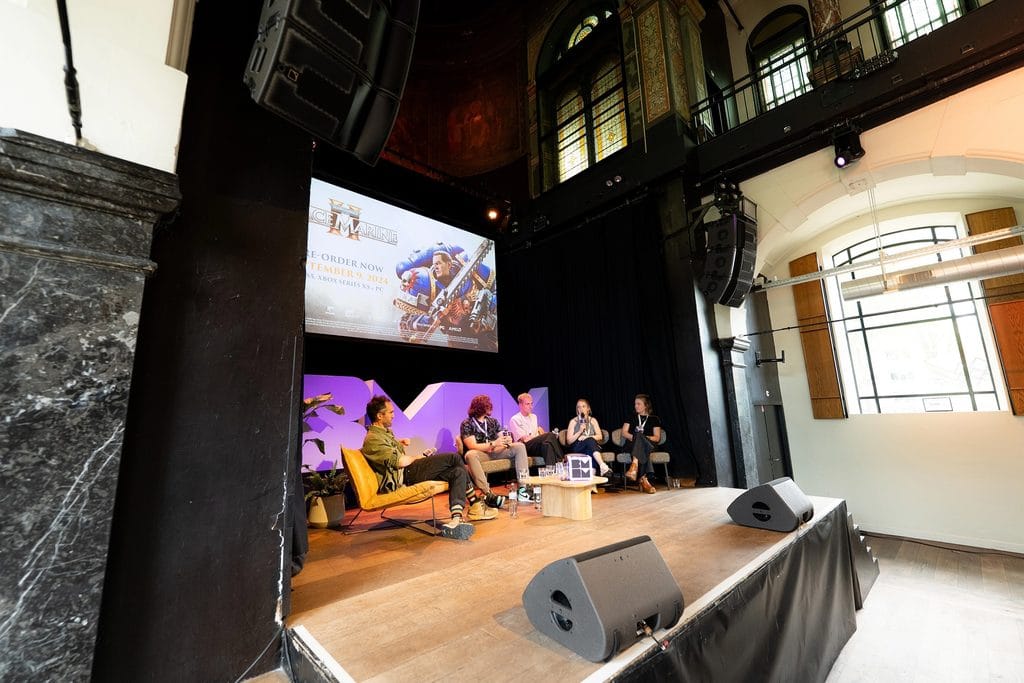
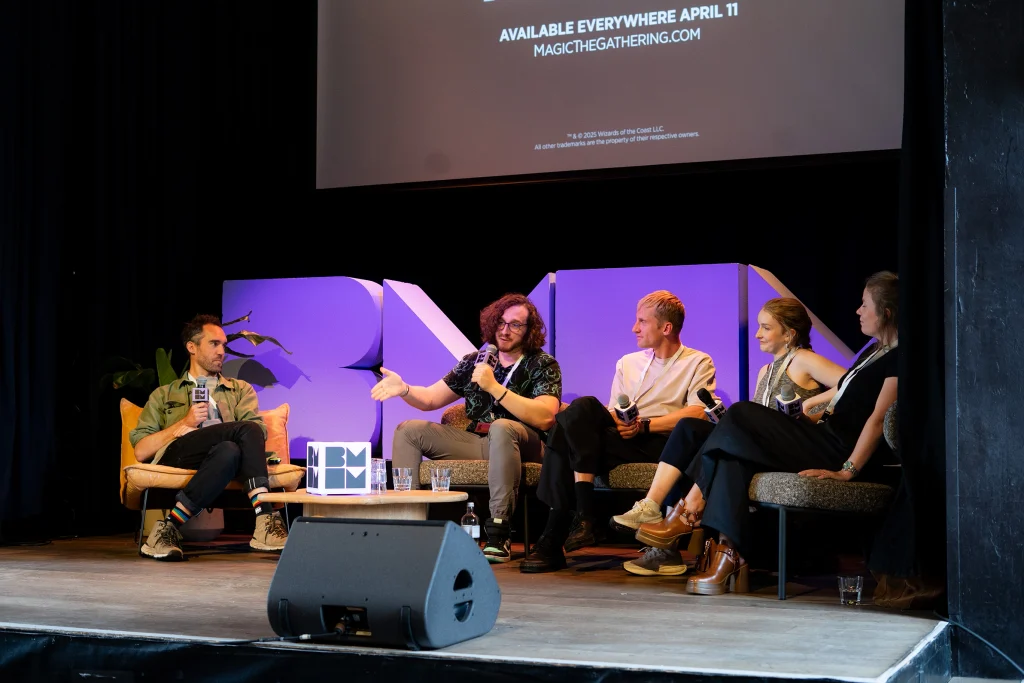
During the BMIM Conference, music supervisor Jarl Hector of Clear Music spoke with trailer composer Hermann ‘Mr. Herms’ Schepetkov, executive producers Chris Wenting and Jade Schiff, and Steacy McIlwham of Avalanche Studios about this process. How early do you want to involve music, and what is the best approach? What happens if the licensing doesn’t come through on time? And how much room is left for a composer when a client has already fallen in love with an existing track?
The panel agreed on one thing: music works best when it becomes part of the creative process early on. “From my personal perspective, the musicians team should be onboarded from the first second on,” Hermann noted. “They should be onboarded on the second where you have the alpha drawings, and they say, ‘This is the storyboard.'”
Music as a Starting Point
For Chris, this ideally begins during pre-production, when storyboards and animatics are still being made. Especially when animation is closely tied to choreography, lip-sync, or musical rhythm, clarity is needed early on. “As soon as possible,” he said about the moment music should be involved. “But that’s not always what the client wants.” And there lies the familiar catch: before a production can truly choose a musical direction, the client often still needs to make several decisions.
At VFX and animation studio Mathematic, Jade tries to reverse that process. There, sound design is already utilized before the final footage exists. “We are really using sound before creating visuals,” she explains. “It’s never the final version, it’s always mock-ups. It’s always just to bring creativity and to define what kind of visuals we’re gonna make.” This can also mean that a client hears something they never actually asked for. According to Jade, that is exactly what makes it interesting. “So when we come up with creative soundtrack or sound design proposals, it’s always something that questions them.”
For Hermann, this is precisely the moment when a composer can add value. It becomes much more difficult when the edit is already locked. “The trailer is cut to something, or in the best case cut to no music at all, and they say, ‘Okay, make it work.’” Especially with music that has a fixed tempo, this causes problems. Cuts made without taking musical rhythm into account cannot always be forced into a track after the fact. This generally has a negative effect on the final result.
Starting early does not mean everything is set in stone thereafter, as demonstrated by K/DA – MORE, the League of Legends production Chris worked on. The track used for the initial pre-production and storyboards was different from the final song. Subsequently, the COVID-19 pandemic broke out during production. Dancers had to record motion capture remotely, and temporary vocalists were used to further develop the choreography and animation. On top of that, the song featured four different languages. What started as an early and closely integrated process therefore remained fluid right up until release. “I was exporting the latest version… an hour before it came online.”
Conversely, with the launch trailer for Warhammer 40,000: Space Marine 2, Hermann came in relatively late. The footage was largely locked. This time, the music had to adapt to the existing edit. The briefing made all the difference here. The main character, Titus, begins the trailer defeated and must gradually pull himself together. Hermann saw something classic in this. “It’s basically the Greek hero saga where you start defeated and start moving, and then you get kind of on top of things, and then everything falls down again. But then you get back up again, or you envision you are getting back up again.” The latter is essential, according to him. “Which a trailer should do, because people should buy the game and play it and not like have a finished movie.”
People should buy the game and play it and not like have a finished movie.
But even when the story is clear, the musical interpretation can differ per scene. Hermann points to a moment when a massive group of enemies charges at the Space Marines. “We had that moment that we said, ‘That needs to be happy, that’s already glorious.’ And then the client said, ‘Oh no, no, no, we’re about to get killed here.’” The sound itself also changed. “I was very angelic, very like a church, very sacral, I would say, and we kinda moved away from that at a certain point because we are still shooting with guns at monsters.”
And Then Your Track Disappears
Even when music is the starting point of a trailer, that choice can still vanish later on. Jade talks about a production where the client had chosen an existing song. It was a distinct track upon which the animatic and the trailer were subsequently built. “And three weeks before the delivery date, they changed their mind,” Jade continues. “And they sent us an original composition, very different.”
“It happened to me a few times that also the higher-ups’ higher-ups haven’t seen it yet,” Jarl adds. “’Everything needs to be Guardians of the Galaxy’ until they want to deliver it… ‘Oh no, it needs to be Gen Z, completely different, two weeks, good luck.’”
Of course, it also happens sometimes that a track cannot be cleared. In such a case, another pitfall lies in wait: the sound-alike. According to Hermann, you are almost never asked literally via email to recreate an existing song. The phrasing is more subtle: the client has seen the trailer with a certain track and wants to proceed based on that feeling.
He personally tries to win such assignments precisely by not copying.
Then there is often already a case of what he calls ‘mood love’. Someone has become so accustomed to the temporary music that every alternative is compared to something that is actually impossible to beat. He summarized the briefing that follows as: “Bold, original, unique… copy what we have.” He personally tries to win such assignments precisely by not copying. “I have a history of winning those by doing something entirely else.”
Jarl sometimes tries to prevent this problem earlier on. If a client wants ‘something like Oasis’, for example, he doesn’t always send that specific track to a composer. He prefers to translate the reference to Britpop, a specific guitar sound, or other musical characteristics. This way, the original song remains more of a direction, rather than a mold that the new composition must conform to.
Building Trust
Towards the end of the panel, the conversation turned to a trait that sounds less creative but is at least as important in practice: reliability. “You will lose every job to everybody who is more reliable than you,” Jarl noted. A composer can be exceptionally good musically, but if a producer doesn’t know whether a file will actually arrive at the agreed-upon time, someone else ultimately becomes more appealing. “If that person says 6 PM and it will be 6 PM, he will be hired.”
Steacy immediately recognized this from her work at Avalanche Studios. Especially with live games, releases are announced in advance, and players are waiting for new content. “We don’t have the opportunity to say: ‘Ah, we can wait another month.’” Precisely in this lies an advantage for independent composers. Clearing a song from a major artist can take time. Approvals need to come in, budgets have to be right, and various rights holders may be involved. A composer who can deliver quickly and handles changes flexibly can ultimately be more practical than the perfect existing track.
From License to Brand Identity
Finally, a question from the audience asked whether the industry is moving more towards licensed music or towards original compositions. Steacy primarily sees the latter movement. “There’s definitely overall a push that I’m seeing towards originally composed music.” A large part of this has to do with rights. “When you own your own music, everything is just easier.” When making deals with platform partners, for instance, studios must be able to prove exactly who owns which music. But according to her, there is also a creative advantage: “You really get to own your musical brand and how that connects with your players.”
That does not mean familiar tracks will disappear from major game trailers. Particularly with AAA releases, an existing song can immediately evoke a cultural association. Steacy mentioned Battlefield 1, where Seven Nation Army instantly gave the campaign a recognizable feeling. However, a studio must have the scale, budget, and legal clout for that. Meanwhile, Hermann sees that original music is also becoming more accessible on the other side of the market. Smaller and independent games can collaborate with composers increasingly easily. “We have so many talented artists that can produce from their bedroom amazing pieces as well.”
Text: Arjan Ranjbar
Photos: Birgit Bijl