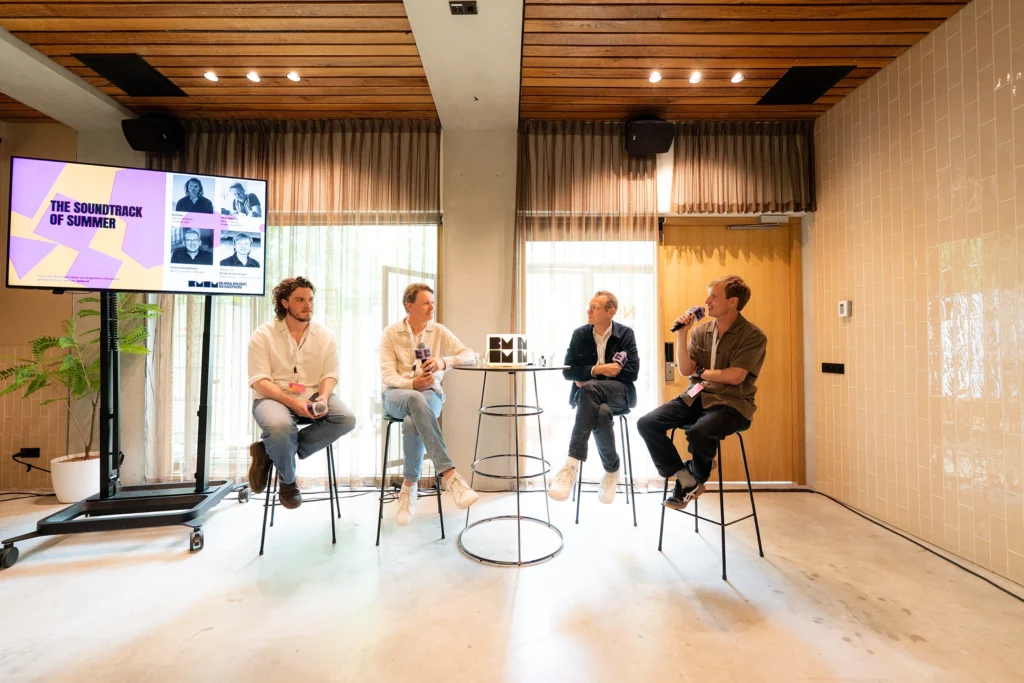
What begins as a montage beneath a handful of football clips can still give you goosebumps twenty years later. During BMIM Conference, Diederik van Zessen joined Jeroen Stomphorst, Thijs Mantel, and Remme ter Haar to explore how certain songs can lodge themselves in our collective sporting memory. Sometimes it starts with a little CD in a car. Sometimes with a ballad that is rebuilt. And sometimes with an editor who knows exactly where image and music meet and reinforce each other.
There are summers of sport that you do not just see but immediately hear as well. A summer that settles not only into images but, above all, into sound. And eventually, into your mind. The arms raised in celebration, the empty stare after a defeat, the slow motion, and then, almost automatically, that one song starts playing along again. First, you recognize it. Then you expect it. And years later, three seconds are enough to take you straight back.
During the BMIM panel on the Summer of Sport-hit, Diederik van Zessen delved into this phenomenon with NOS stalwart Jeroen Stomphorst, industry veteran Thijs Mantel, and singer-songwriter Remme. Diederik had already set the ball rolling in two earlier pieces on his own blog Sport Sounds: one about Wenn Es Passiert by Wir Sind Helden, perhaps the best-known NOS summer-of-sport hit of this century, and one about The Moment by Remme, which suddenly reached an audience of millions during the postponed European Championship in 2021. Those stories came together during the panel.
The central question: how does a song become the sound of a summer of sport?
The Montage Before the Myth
At NOS Sport, the montage accompanied by a single song has now become a familiar ritual. Traditionally, the day’s sporting action is condensed into a few minutes: goals, looks, tears, delays, crowds, and details you may have missed during the live broadcast. Music does something to those images: it lifts a day out of the present moment and pushes it towards memory.
The panel began with U2’s Beautiful Day, used around the Sydney Olympic Games in 2000. Sunshine, medals, euphoria, a chorus that immediately bursts open. Thijs Mantel explains why sport is so powerful for music: “You always have to look for ways to convey emotion if you want to break through in music. And sport and emotion are very clearly one and the same.”
The Little CD in the Car
The most striking example remains Wenn Es Passiert by Wir Sind Helden. In his earlier article, Diederik had already described how an album track by a German band that was virtually unknown in the Netherlands grew into the soundtrack of the 2006 World Cup. During the panel, Jeroen explains how spontaneously it came about.
He had only recently started working at NOS and still regularly visited the music desk at his former employer, 3FM. They would give him CDs to take with him. One of them was lying in the back of his car. When someone in the newsroom asked whether anyone knew ‘a good track’ for the World Cup montage, he thought of that German album. “I’ve still got a little CD in the CD changer in the back of my car,” Stomphorst said. Video editor Milko Bloemraad put the song underneath a compilation. And at that point, the decision had effectively already been made. “It worked immediately,” Jeroen continues. “I’ve seen it a hundred times, and it still gives me goosebumps.” The lyrics helped, of course. “Ich will da sein, wenn es passiert.” I want to be there when it happens. As though it were meant to be. “Within three seconds, it was done. This is the song.”
Within three seconds, it was done. This is the song.
Diederik asks whether anyone contacted the band to find out how they felt about it. “No, one hundred per cent not,” Jeroen says. “We thought it was good. And we thought, “This is the one.” Good ultimately proved to be an understatement. Viewers emailed and called in large numbers to ask who the band was. Wir Sind Helden eventually performed live in the studio. It even earned the Hamburg-based group a place in the Dutch Top 40. A coincidence, then, but certainly not arbitrary. Because the fact that it worked was also down to the montage. Jeroen emphasized the role of video editors, who build a story from an enormous stream of match footage, stands, tunnels, and seemingly minor moments. “It isn’t just a matter of sticking things together,” he says. “It has to feel right.”
A Ballad with the Rhythm of a Match
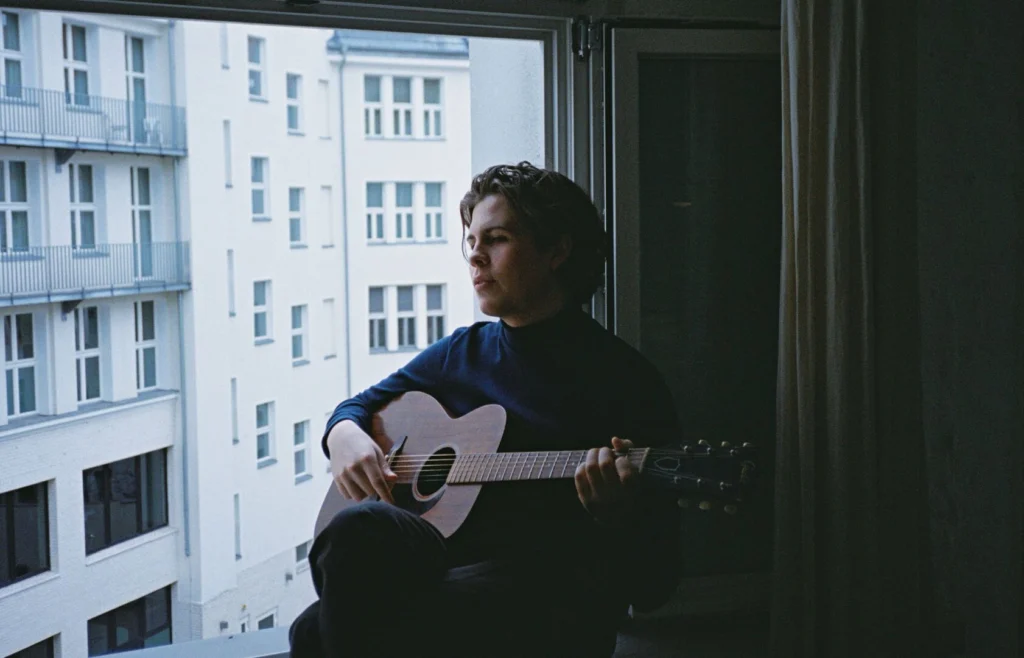
Whereas Wenn Es Passiert emerged largely by chance, The Moment by Remme shows how strategy and timing can come together. Diederik had already written on his blog about the 2021 European Championship, a tournament that had been postponed for a year because of the coronavirus pandemic, while the music industry was also still largely at a standstill. Remme had just released his first single when everything shut down. “I really am a live artist,” he said. “So that came to a complete standstill.” The question became: How do you get music to people when you cannot perform?
Thijs Mantel, who was part of Universal at the time, saw an opportunity. NOS was looking for music for its European Championship montages, and Remme had a song ready: The Moment. At that point, however, it was still a piano ballad. Beautiful, but not immediately a sports track. So the song was rebuilt. “We got to work like crazy,” Remme explains. The song became faster, bigger, and lighter. The lyrics shifted as well. From a song about how quickly beautiful moments pass to a track about achieving something together.
That was when I saw how it sounded with those images. Suddenly, you become part of a campaign.
That could have felt uncomfortable: an artist adapting his song for a television format. But Remme saw it differently. “I’m not selling my soul,” he said about it. The ballad could still exist later. This version had its own purpose. It only truly became real when he heard the song beneath the NOS footage. “That was when I saw how it sounded with those images,” he said. “Suddenly, you become part of a campaign.”
The panel also showed that the summer-of-sport hit has become more complicated nowadays. On television, much of the use of music is covered by existing agreements with rights organizations. But as soon as the same montage has to be posted online or on social media, everything changes. Diederik asks whether a song used beneath an NOS television montage can simply be carried over to social media. Thijs gives a brief answer: “No.” Clear enough.
Royalty-free music
In 2006, viewers mainly wanted to know what that German song was called. Now, editorial teams have to take platforms, reposting, rights, and short clips that continue circulating online into account. Commercial parties therefore increasingly opt for royalty-free music. Practical, but rarely memorable. A genuine summer-of-sport hit? That has to stir something.
At the end, the panel looks ahead to the current World Cup. Several possible tracks are discussed, including a single by Kensington. The band now has an American singer, so according to Diederik, it is a good fit for the tournament in the United States. Jeroen then comes out with a scoop: the song Where We Go by Marshmello will be used by NOS for football montages this summer (besides Milky – Just The Way You Are – David Guetta Remix and The Rolling Stones – In The Stars – Cirkut and Andrew Watt Remix, ed.). Opinions differ. Too polished, not enough emotion, appropriate for America; a shame it is not a Dutch artist. A track made partly with AI is also tried; the audience responds cautiously.
No fixed formula
Above all, this makes it clear that there is no fixed formula. A summer-of-sport hit has to return often enough to become familiar while leaving room for both images and imagination. It has to carry emotion without forcing it. Success for the Netherlands helps but offers no guarantee. Sometimes melancholy actually works better. What is essential? An editor with instinct, a video editor with a sense of timing, an artist or label that recognizes an opportunity, and a song big enough for millions of people to connect to their own summer.
And when it works, a single line is all you need.
Text: Arjan Ranjbar
Photos: Birgit Bijl